Natural static electric fields: Sam J. England
The third scientist out, at the event at house of Literaure in Oslo that I am covering (Rohde, 2025), about the decline in insect populations in the World, was Sam J. England with a presentation on static electric fields.
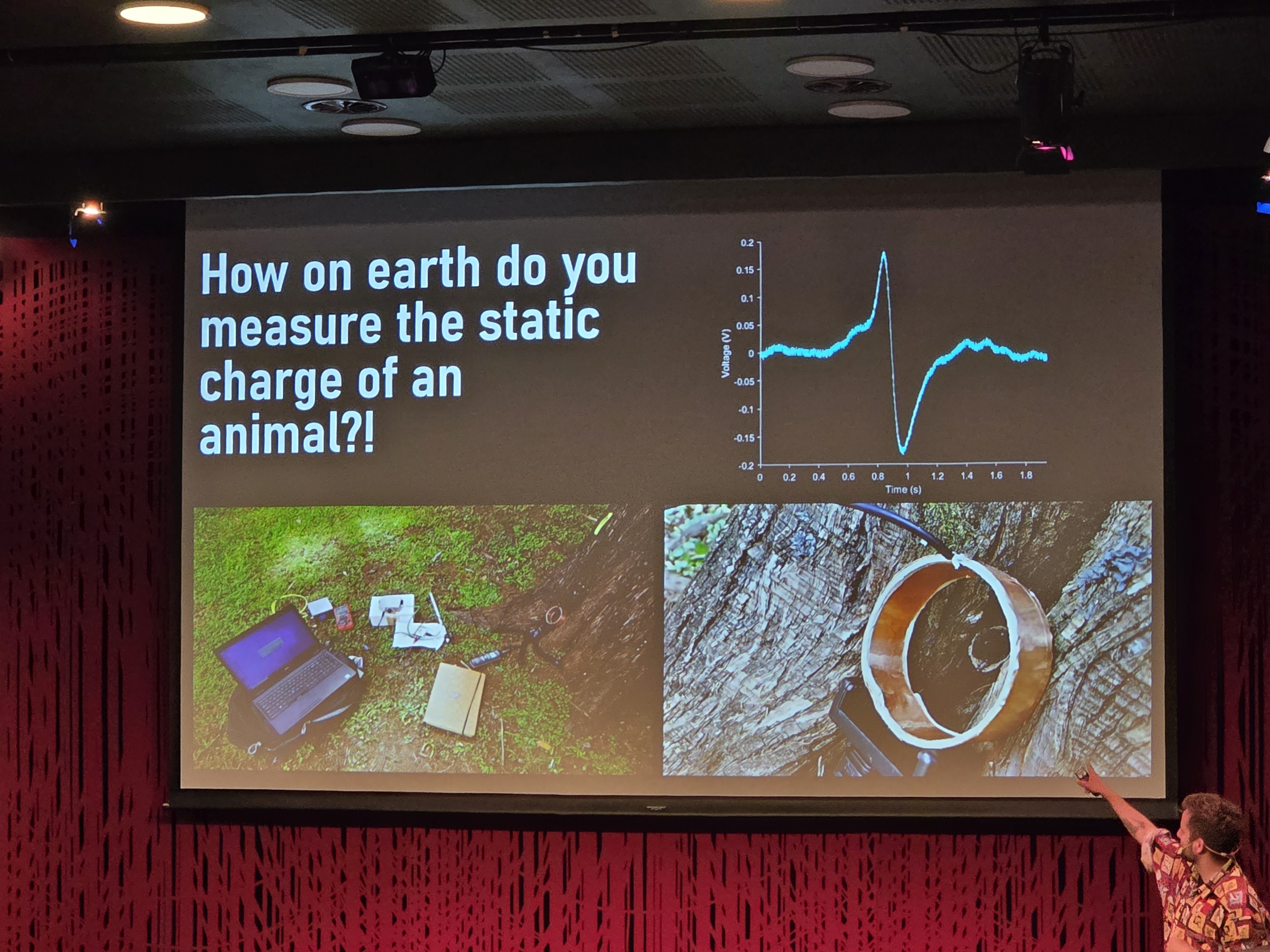
What is static fields and how are they measured
Such static fields are created by charge. For instance a negatively charged surface, creates a field wherein positively charged particles will attract (and negatively charged particles repel). The classic example is the field you can create around a balloon if you rub it against a synthetic carpet, which you then can make visible by trying to put the balloon against the head and see that hairs are atracted.
An interesting question in that regard is how one can measure such fields in tiny insects. In image 1 above, some of the measurement equipment Sam has used in his research, is shown: As an insects flies through a ring, connected to some other equipment, tiny changes in the electric in the air’s electric field, can be measured. Those small field changes one detects, is the electric charge of the insect.
Another thing England mentioned was that there is actually an electric field in the air outside. England and collegues has actually done research on this field finding finding that such fields remains stable underneath a tree, despite an overall change in the atmospheric field (Hunting et al., 2021). The field is known to vary due to several reasons, but during so called fair weather, it’s about 100-200 V/m. I needed to research this field myself for my master thesis (on how people’s residential floor level, may relate to their health) [@]. In the figure below the field is visualized by Richard Feynman. Simply put, this means that there is a lot of charge in the air outside (but you won’t get an electric schock because of the low conductivity of air; the charges moves and dicipates/transfers very slowly).
Static electric fields are actually something quite different than the elctromagnetic fields or radiofrequency radiation we use in communication technology. It discerns. Simply put, static electric fields have no frequency; they are not waves that propagete through space. Instead they, in a a way, just are. They are static, fixed. Without motion. But they constitute a force, that can pull or push on other charges.
And importantly, in the context of Sam England’s presentation, we are also mainly talking about how such fields just simply are a natural part of biological life, and what function they serve for biological beings.
Simply put, insects and their surrounding can have a charge, and when they do have charge, they consitate a static electric field.
But, I believe Sam tried to underscore this: The simple fact that insects by nature are electric, does not equate to saying that electromagnetic fields (radiation) from cellphones, for instance, have a negative impact on insects. It’s a logical fallacy: After all, we already know that life is also chemical in nature, but that does not mean that any and all chemical exposures must have an important biological or health impact.
What this line of research is simply saying, is just that life, in addition to being chemical in nature, is also electric.
When the existence of such static fields have been established, it also raises the question: What is the meaning of this electrical nature? Why do insects have or utilize electric charge? This question is what England gave us a a glimpse of some answers to.
Sam is far from the first researcher to try to answer such questions about electricity in animals or insects, but he might at present be at the forefront in his field.
Research profile: Sam J. England

Click to expand a full list of Sam J. England’s research (in Semantic Scholar)
England is a young scientist, but already has a relatively long publication list.
England took his PhD at the University of Bristol, and is currently a postdoctoral fellow at Museum für Naturkunde Berlin.
With his talk at the event in Oslo, he also demonstrated excellent research communication skills. I have personally followed Sam England’s research for a couple of years, and his research, and profile, falls within a category that would easily have been picked up by the science section of any bigger Norwegian media outlet with a science section, if they had known about it. It is ground/rock?(?) solid science. Also, there is no controversy in basic research on the hidden life of insects per se - when we leave human impact and electromagnetic pollution on the natural life out of the equation – so it is likely that even conservatice journalist would consider it a “safe” topic.
I even belive that the Norwegian tabloid media could have found some of England’s research interesting: He has studied ticks, which is a topic that is often written about in the Norwegian news media. That they did not show up at the event at the house of Literature in Oslo, was indeed a missed opportunity for them.
However, England’s scientific records also show that he recently picked up scientific interest in the environmental impacts of radiofrequency electromagnetic fields (RF-EMF) [@] (the study is not yet indexed in Semantic Scholar), and he also briefly touched upon such studies towards the end of his presentation.
Since England’s most recent study did not reach his Oslo presentation, I think this is a good opportunity to give a extremely brief review of its findings. As stated in the title it found that “[r]adiofrequency electromagnetic fields reduce bumble bee visitation to flowers”. The research group were able to “simulate realistic Wi-Fi radiation at 2.450 and 5.805 GHz (simultaneously)”, that they exposed the bees to.
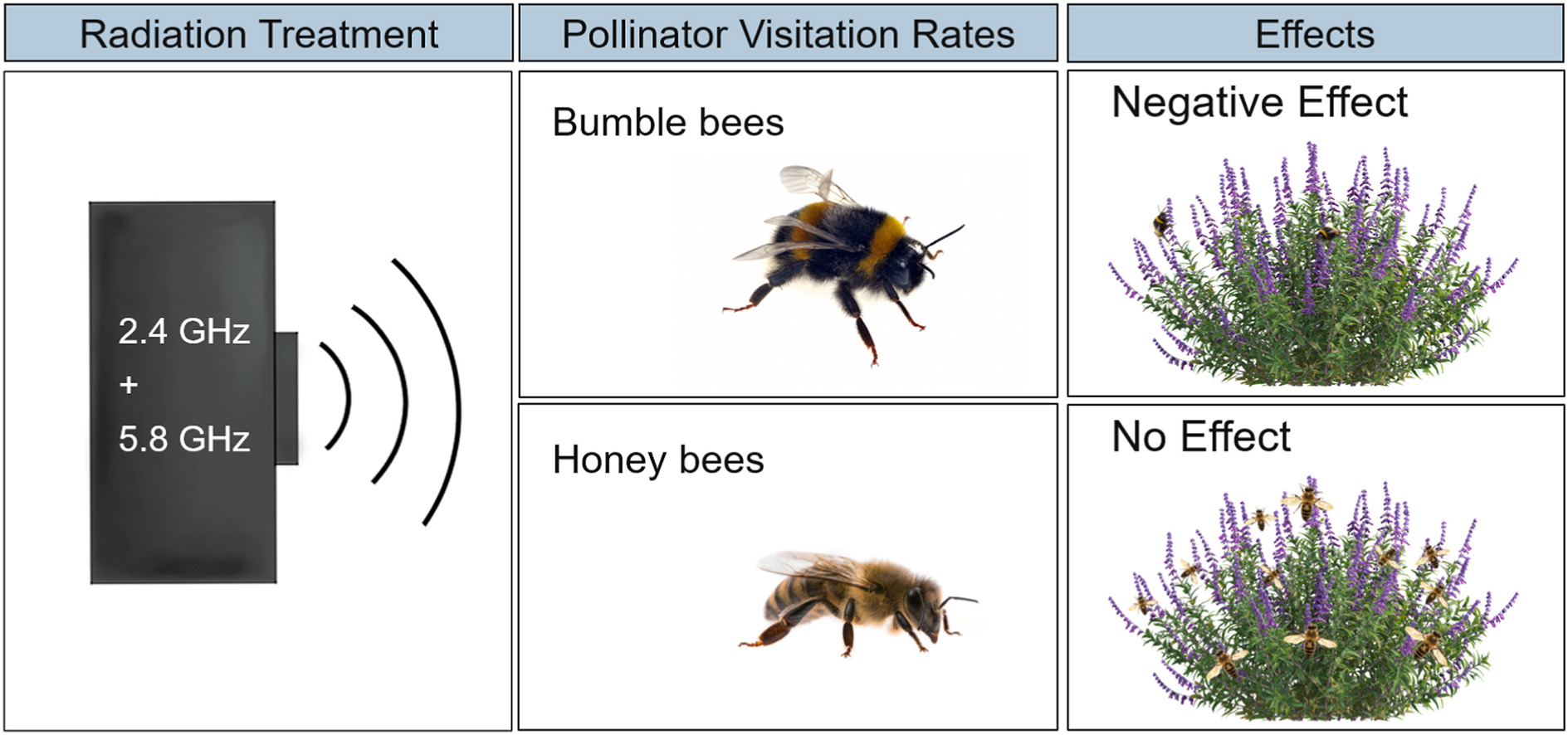
The graphical abstract from the article, shown above, also shows that this effect was only present in bumble bees, and not honey bees.
Three domains where natural static electric fields are utilized in nature
England’s research interest has layed mainly within the benefits of natural electric fields for insects - how nature utilize such fields. According to England the fields are utilized in three main areas og (1) pollination (think flowers and bees), (2) parasitism (e.g. ticks) and (3) by predators and preys (e.g. a catepillar sensing a wasp).
A short description of these three main areas, based on England’s presentation, is as follows:
- Regarding pollination, flowers are mainly negatively charged by the ground, while bees easily loose any negative charge during flight, and become positively charged. Evolutionary, it helps the flowers that their negatively charged pollen more easily attract to positively charged bees, and thus their pollen can spread with the bees flying around.
The field is also utilized by the bees, which can sense which flowers have already been visited, so that they maximize their efficiency when collecting nectar.(Visited flowers will temporarily loose their negative charge, before they are slowly recharged.)
- Parasites also use the electric field. For instance, did you know that ticks cannot really jump, in the tradiational sense, using their legs? Instead they use static electricity to get onto a host, such a cow. A scientific question therein is much charge that is involved in such “jumping”.
- In the third category, the predator-prey relationship, a question is if static electricity can be a sensory cue utilized by predator and prey? Yes, it can. But how are they detecting it? The catepillar, that need to avoid wasps (that eat them) can actually “hear” the charge, according to England. Scientifically this has been found using LaserDoppler vibrometry. England stated, that it is quite interesting that catepillars do not have to carry any charge themselves to be able to detect the charge in the wasps. (I guess catepillars, in that manner, also avoid being detected themselves by predators.)
A few theories on effects of electromagnetic pollution from power lines
After having provided the audience with a basic understanding of static fields and charge, England looked at a few theories of electropollution from power lines can affecting insects.
- Catepillars are interesting for electropollution. They have been shown to be highly sensitive to 50 or 60 Hz electromagnetic fields. In idea here is that such fields, may be trigging them to think that there is always a predator presents
Downward of power lines the ion concentration (concentration of electric charges in the air) is disturbed [@ ] (Matthews 2024). This change in air ion concentration could a be be a mechanism additional to the 50/60 Hz field frequencies of high voltage power lines.
In addition chemical factors such as fertilizers, can make its effects on plants and insects by diosturbing the electric fields of plants. When the fields are disturbed it can then in the in the next step also disturb or confuse the insects.
I can add a reference about one recent study that has been written about: (See if this fits to comment on: https://www.newscientist.com/article/2373396-electromagnetic-fields-from-power-lines-are-messing-with-honeybees/)
As I mentioned, recently, Sam J. England has picked up an research interest in radiofrequency electromagnetic fields (radiation) and their possible negative impact on bees. As I was writing this, an article was published in …., with the title….
Humans and static electricity
Since the topic is static electricity, I have to mention one thing, outside of England’s presentation. When I wrote my own master thesis in public health [@ ], I came a across a 1998 master thesis in physics that have crossed my mind many times since.
In the introduction of her thesis, Anne Catrine Trægde Martinsen, now professor at Oslo Metropolitan University,states that is was the first publication where one had tried to measure the static charge in humans throughout a whole day at work, while earlier works had only measured the human charge over much shorter time intervals [@].
I haven’t come across any similar research since.
Image from page 47
Trægde Martinsen’s was actually written for it’s relevance to health, in the following way, described in the very first paragraph of the thesis (translated from Norwegian):
Static electric fields around a person’s head probably cause increased particle deposition on the face. This particle deposition can in turn lead to skin problems. A person can become statically charged through triboelectric effects, i.e. through friction electricity. For particle deposition, what is decisive is the field strength between a charged person and an object with a different potential. When the person is sitting in front of a computer screen, it is the field strength between the person and the computer screen that determines the extent of particle deposition.
[…]
There are several reasons why it may be interesting to study a person’s static charge over a longer period of time. One reason is the discomfort one may immediately feel when touching an object with a completely different potential than oneself. Another reason is that a person who is charged more easily attracts dust, bacteria, viruses, and pollen. In this regard, it is the average charge over a longer period of time that seems most interesting.
That being said, there is no direct relevance of Trægde Martinsen’s work on static electric charge of humans, to Sam’s presentation about static electricity in insects, but since her thesis has glued so firmly to my mind, I figure others may also find it interesting to be familiar with its existence. Unfortunately the thesis is only available in a physical copy to borrow from the libaray at the University of Oslo. I really hope that it can be digitalized and made available online soon.
Limited research opportunities
I briefly got to talk to England after the event, and he restated what he also mentioned during the panel discussion at the end of the event: Opportunities for research in this area are limited.
Even so, I indeed hope England will succeed in attracting research funds, and continue on his path, of both producing excellent research and research communication.
At a time of decline in insect populations, more knowledge is needed about all aspect related to insects. Basis research, such as that which Sam England has conducted, can help enhance human knowledge on insects, that may later prove to be vital in also understanding the decline in insect population and how it can be stopped and the trend has turned.
References
Hunting, E. R., England, S. J., & Robert, D. (2021). Tree canopies influence ground level atmospheric electrical and biogeochemical variability. Frontiers in Earth Science, 9, 671870. https://www.frontiersin.org/journals/earth-science/articles/10.3389/feart.2021.671870/full
Rohde, M. (2025). European Scientists Gather to Discuss Electromagnetic Fields, Insects, and the Global Insect Decline: Episode I, Flydal & Nordhagen. EpiWaves Blog. https://madsrohde.com/posts/en/emf-seminar-oslo-2025-episode-1/
Footnotes
Photo by Mads Rohde, 2025. Licensed under CC BY-NC 4.0.↩︎
Image from the Internett.↩︎
Citation
BibTeX citation:
@online{rohde2025,
  author = {Rohde, Mads},
  title = {European {Scientists} {Gather} to {Discuss} {Electromagnetic}
    {Fields,} {Insects,} and the {Global} {Insect} {Decline:} {Episode}
    {III,} {Sam} {J.} {England}},
  date = {2025-11-30},
  url = {https://madsrohde.com/posts/en/emf-seminar-oslo-2025-episode-3/},
  langid = {en}
}
For attribution, please cite this work as:
Rohde, M. (2025, November 30). European Scientists Gather to Discuss
Electromagnetic Fields, Insects, and the Global Insect Decline: Episode
III, Sam J. England. EpiWaves Blog. https://madsrohde.com/posts/en/emf-seminar-oslo-2025-episode-3/